The Overwhelm Bathtub: Understanding emotional overwhelm
Have you ever reached a point where it feels as though everything is just too much? This is emotional overwhelm.
Perhaps you have things to do at work, responsibilities at home, relationships that need your attention, decisions you need to make and worries that keep circling in your mind, and somehow there doesn’t seem to be enough space left for you.
You might find yourself feeling stressed, anxious, irritable, exhausted or emotionally overwhelmed. Sometimes even small things can suddenly feel like the final straw.
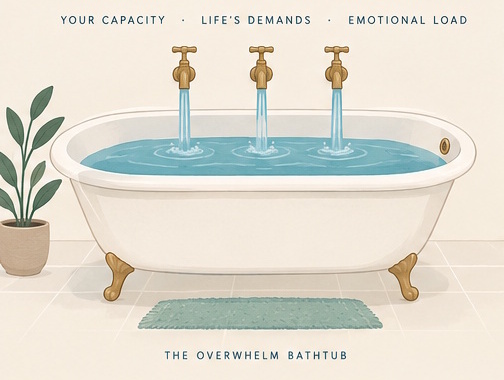
I sometimes use an analogy with clients that I call “The Overwhelm Bathtub”. It’s a way of thinking about stress, emotional overwhelm and our capacity to cope with the demands of everyday life.
What is the Overwhelm Bathtub?
Imagine that your capacity to cope is a bathtub. The bathtub represents the amount of mental and emotional space you have available at a particular time. This is measuring our emotional overwhelm.
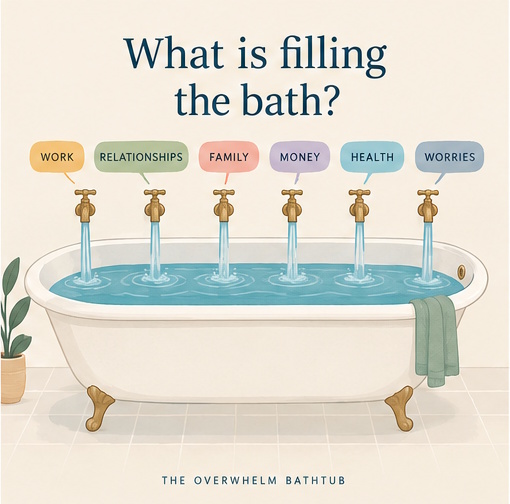
Now imagine that water is flowing into the bath from several different taps. Each tap represents something that requires your attention, energy or emotional resources. One tap might be work; another might be family or relationships.
There might be taps for finances, parenting, health, household responsibilities, difficult decisions, uncertainty, expectations or worries about the future. And sometimes several taps are running at the same time.
The water represents everything that is currently asking something of you.
How full is your bathtub (aka recognising emotional overwhelm)?
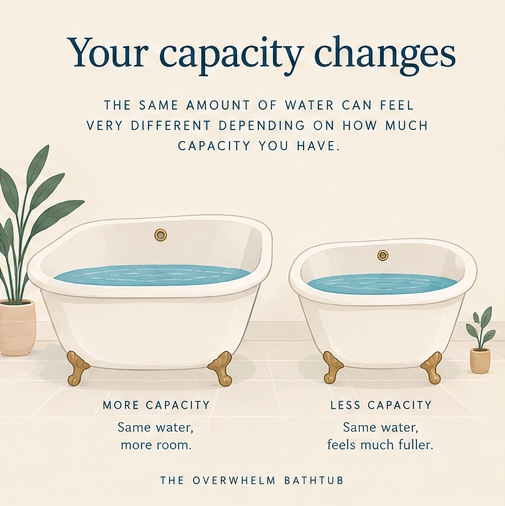
One of the interesting things about this metaphor is that the size of the bathtub isn’t necessarily the same every day. There may be days when you feel rested, supported and relatively resilient. Your bathtub feels large, and you have plenty of room for whatever comes your way.
On other days, perhaps because you’re tired, stressed, grieving, unwell or already dealing with something particularly difficult, your available capacity may feel much smaller. The same situation can therefore feel very different depending on how much is already in your bathtub.
This can be an important part of understanding why something that normally wouldn’t bother you can suddenly feel overwhelming. It may not be that you’ve somehow become less capable.
Your bathtub may simply already be very full.
What happens when the water level rises?
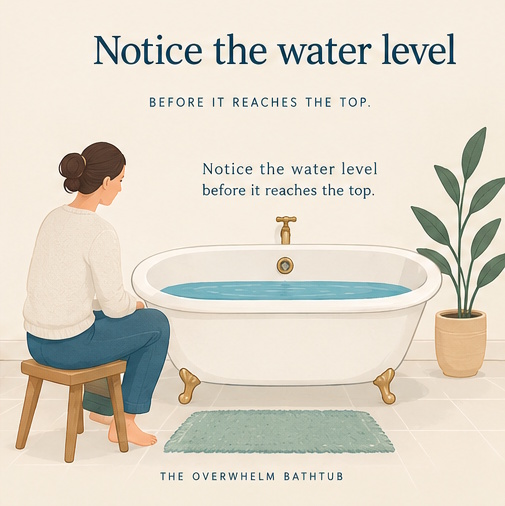
As more water enters the bath, the level gradually rises. At first, you might not notice. Then you realise that the water is getting higher.
Perhaps you’re coping reasonably well at 50%. At 70%, you might start to feel the strain. At 90%, you may find that there isn’t much room left for anything else.
This gives us a useful question to consider: “How full is my bathtub at the moment?”
It’s a surprisingly simple question, but it can encourage us to become more aware of our own emotional and mental capacity.
The overflow pipe
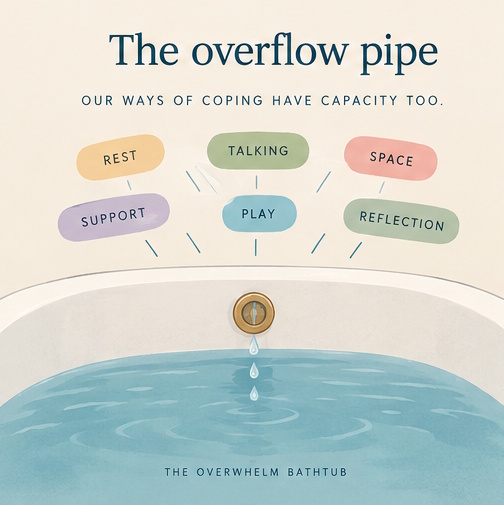
Most bathtubs have an overflow pipe. In the metaphor, this represents some of the things that help us manage stress and regulate ourselves when life becomes demanding.
Perhaps we talk to someone we trust. Perhaps we take some time alone. Maybe we sleep, exercise, spend time outdoors, laugh with friends, pray or reflect, engage in a hobby, or simply have an opportunity to process what we’re experiencing. These things can sometimes help stop the water level from continuing to rise.
But the overflow has its limits. If water continues pouring into the bathtub faster than it can leave, eventually the water reaches the top.
When we become overwhelmed
This is where emotional overwhelm can become particularly difficult. You might notice that you’re becoming more irritable or tearful. You might struggle to concentrate.
Making decisions may suddenly feel exhausting.
You may find yourself worrying more, sleeping poorly, withdrawing from other people or feeling as though you simply cannot take on one more thing.
Sometimes people describe this experience as “burning out”, “crashing”, “having a breakdown” or “reaching my limit.” But it isn’t necessarily one particular problem that has caused it. It may be that the bathtub was already full before the latest thing came along.
That final demand may simply have been the one that caused the water to spill over.
Can you turn one of the taps down?
One of the most useful aspects of the Overwhelm Bathtub is that it gives us another way of looking at stress.
When the bath is getting full, we might naturally think: “How am I going to deal with all of this?”
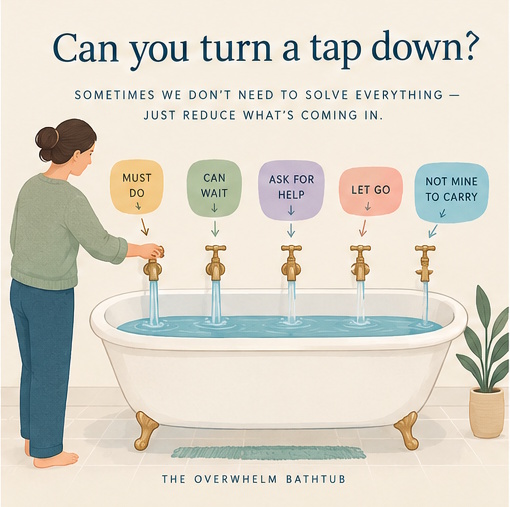
The metaphor invites another question: “Is there a tap I can turn down?”
Perhaps something doesn’t need to be done today. Perhaps a commitment can wait. Perhaps somebody else could help. Perhaps something that you have been trying to do perfectly could simply be done well enough. Perhaps you have been giving a lot of mental energy to something that you cannot currently control.
And sometimes a tap cannot be turned down. There may be situations involving work, family, health or relationships that simply have to be dealt with.
But even when one tap has to keep running, there may be other taps that can be reduced temporarily. The aim isn’t necessarily to empty the bathtub. It’s about creating some space.
Prioritising when everything feels important
When we’re overwhelmed, everything can begin to feel equally urgent. The metaphor can offer a different perspective. If your bathtub is already nearly full, you may need to consider what genuinely needs your attention right now.
What is important? What can wait? What could be shared with someone else? What are you carrying that perhaps doesn’t need to be carried today?
This isn’t about judging yourself for having too much to deal with. It’s about becoming more aware of your own capacity and the demands being placed upon it.
Self-care isn’t just about relaxation
When people talk about self-care, it can sometimes sound as though the answer to stress is simply to have a relaxing bath, take a day off or do something enjoyable. Those things can certainly matter.
But self-care can also involve something deeper: paying attention to your own limits. If you continually add water to a bathtub without noticing how full it has become, eventually there may be nowhere else for the water to go.
Similarly, if we continually take on responsibilities, commitments and emotional demands without considering our own capacity, we may eventually find ourselves overwhelmed. Self-awareness can therefore be an important part of caring for ourselves.
Your bathtub isn’t the same every day
Perhaps one of the most important things to remember is that your capacity can change. You might cope easily with something one week and struggle with it the next (i.e. hitting emotional overwhelm). That doesn’t necessarily mean you’ve gone backwards.
Perhaps you are carrying more water. Perhaps you’ve had less opportunity to let some of it drain away. Perhaps something unexpected has happened. Perhaps your bathtub simply isn’t as large today.
Recognising this can help us move away from judging ourselves for not coping “as well as we normally do”. Instead, we might become curious. What is different today? What is filling my bathtub? What do I have capacity for right now?
What does your Overwhelm Bathtub look like?
We all have different things that fill our bathtubs. For one person, it might be work pressure. For another it might be caring responsibilities, relationship difficulties, financial worries or uncertainty about the future. For someone else, it might be a combination of many relatively ordinary things that have gradually accumulated.
And sometimes the water isn’t immediately obvious. We can carry thoughts, emotions and worries quietly for a long time without acknowledging how much space they are taking up.
The Overwhelm Bathtub is not intended to be a formula for measuring stress. It’s simply a way of becoming curious about our experience.
How full is your bathtub? What taps are currently running? Are you getting close to the overflow? And, perhaps, is there anything that could create a little more space?
If you decide to explore this in therapy
If you decide to embark on some therapy, the Overwhelm Bathtub can become more than simply a way of describing stress. It can become a way of exploring your experience of yourself and your life.
In person-centred therapy, I wouldn’t see myself as someone who knows which taps you should turn off. You are the person living with your bathtub.
You know things about it that nobody else can know in quite the same way: what the different taps mean to you, which ones feel impossible to turn down, which ones you might desperately want to turn off, and perhaps even which ones you have become so accustomed to that you barely notice them anymore.
Our work together might therefore begin with curiosity rather than solutions. We might wonder together about what is filling your bathtub. What does the water feel like when it rises? How do you know when you’re approaching the overflow? What happens inside you when you realise there isn’t much room left?
Perhaps you have learned, over time, to ignore the water level. Perhaps you have developed ways of coping that have helped you keep going, even when the bath has been very full. Perhaps you’ve come to believe that you should be able to cope with more. Or perhaps you have spent so long looking after everyone else’s needs that noticing your own has become unfamiliar.
These aren’t things that need to be answered immediately. Person-centred therapy offers a space where we can slow down and become more aware of what your experience is actually like, without judging it or trying to force it into somebody else’s idea of how you should be.
Sometimes, simply being able to experience yourself as genuinely heard and understood can create a little more space in the bathtub. And as that space develops, you may begin to see your own situation differently. You may become clearer about what matters to you. You may notice needs that have been difficult to acknowledge.
You may begin to distinguish between what you genuinely want to carry and what you have perhaps been carrying because you felt you had to. And, gradually, you may discover your own answers about which taps need attention.
The therapist doesn’t need to tell you which tap to turn. The therapy can provide a relationship and a space in which you can begin to discover that for yourself.
There is no perfect water level
Life will inevitably bring periods when our bathtubs become very full. There will be times when several taps are running and we cannot turn them all off. The goal isn’t to have an empty bathtub. Nor is reaching the overflow a sign that you have failed.
Perhaps the water level is simply information. It tells us something about what we’re carrying and the capacity we have available at that particular moment. And noticing that information – perhaps a little earlier than we normally do – may allow us to pause, reflect and create some space.
So, if life has been feeling like too much recently, perhaps it is worth asking yourself:
How full is my bathtub today? What is filling it? Which taps are running? And where might I be able to create a little more space?
Sometimes, understanding our emotional overwhelm can be the first step towards understanding what we need.
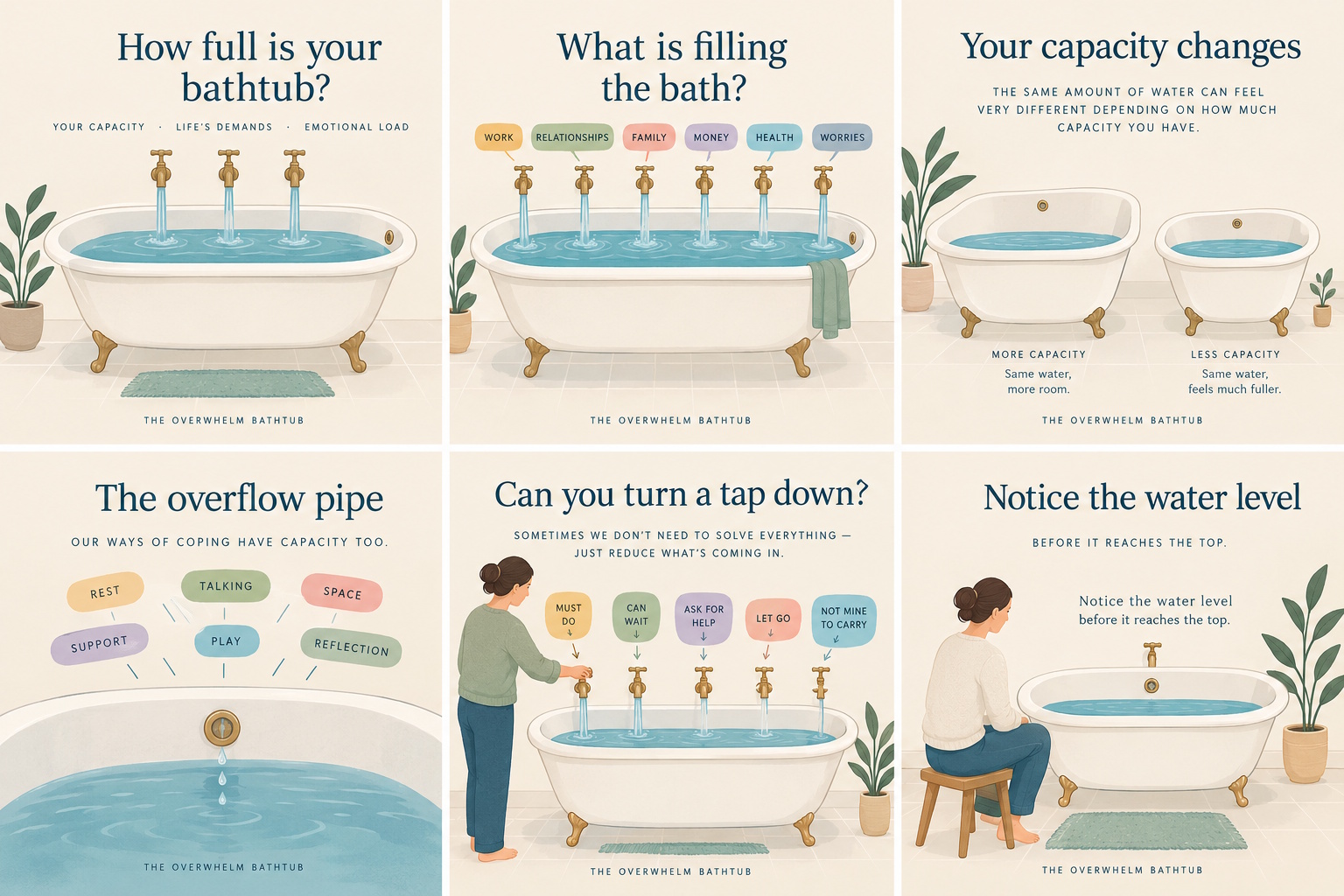
NOTE: You can share the complete Overwhelm Bathtub image by clicking on the buttons that appear on the left or download it by right-clicking on the image and selecting “Save Image As…”
Comments are closed